A Victorian Rose-Cut Diamond Daisy Cluster Ring
A romantic survival from the Victorian era, this diamond cluster ring takes the form of a stylized daisy, its irregular hand-cut rose diamonds arranged as petals around a larger central stone. Each diamond rises gently from its silver setting, creating the soft, shifting brilliance characteristic of rose cuts—a form of cutting intended to gather and reflect the low light of an earlier age.
At the centre is an oval rose-cut diamond, collet-set and encircled by eight individually shaped rose-cut diamonds. Rather than the calibrated uniformity associated with modern diamond jewelry, the stones retain the subtle irregularities of hand cutting: each possesses its own outline, proportions and pattern of facets. Together they form a flower that is deliberately organic rather than geometrically exact.
The use of silver for the diamond setting above an 18-carat gold ring belongs to a long tradition in eighteenth- and nineteenth-century jewelry. Before the widespread adoption of platinum, silver provided the cool-toned setting considered particularly sympathetic to diamonds, while gold supplied warmth, strength and comfort against the hand. Comparable Victorian diamond cluster rings survive with this characteristic combination of silver-set diamonds and gold construction.
Viewed from the side, the construction becomes especially evocative. The diamonds are mounted in a closed-back setting, concealing their undersides and preserving a method of construction inherited from Georgian jewelry. Closed-backed rose-cut diamond clusters in silver and gold continued into the nineteenth century and are particularly associated with antique cluster rings of this character.
The flower head rises above an 18-carat gold shank with elegant open shoulders. Restrained linear detailing at either side provides a subtle transition between the elaborate silver-set cluster and the polished gold band.
The daisy form was particularly suited to nineteenth-century jewelry: the arrangement of a central stone surrounded by smaller diamonds naturally creates a flower without sacrificing the brilliance of the individual stones. Surviving Victorian examples demonstrate the continuing popularity of the diamond daisy cluster during the period.
What gives this ring its particular character, however, is its lack of modern perfection. The rose cuts vary in shape, the facets catch light differently from stone to stone, and the contrast between cool silver and warm gold remains visible. These are not deficiencies to be disguised but part of the visual language of antique jewelry.
Purchased at auction in Chislehurst, Kent, England, the ring survives as both jewel and historical object. Its floral form and diamond setting make it especially appropriate as an antique engagement ring: a love token already carrying the evidence of another century.


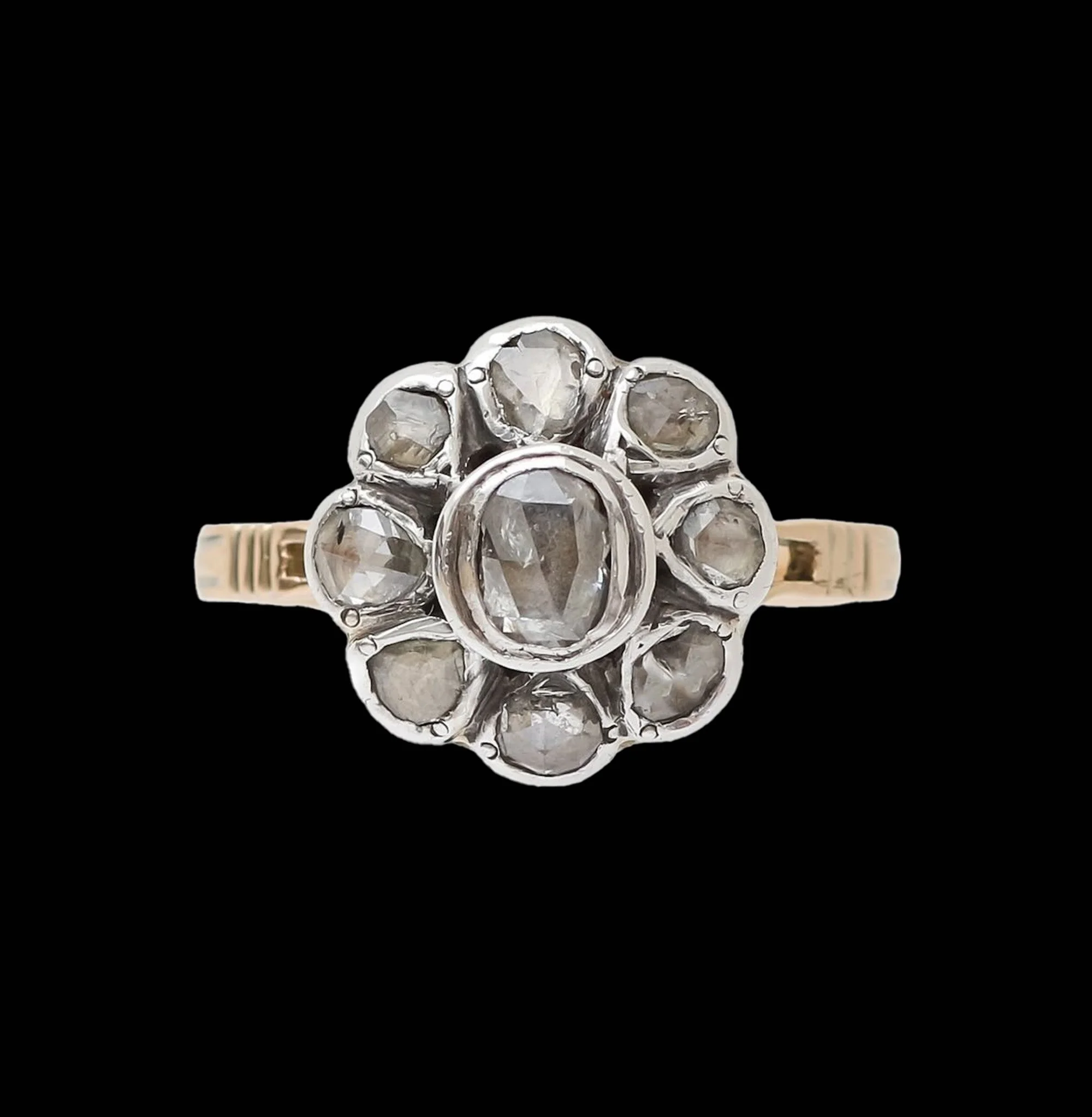 Image 1 of 3
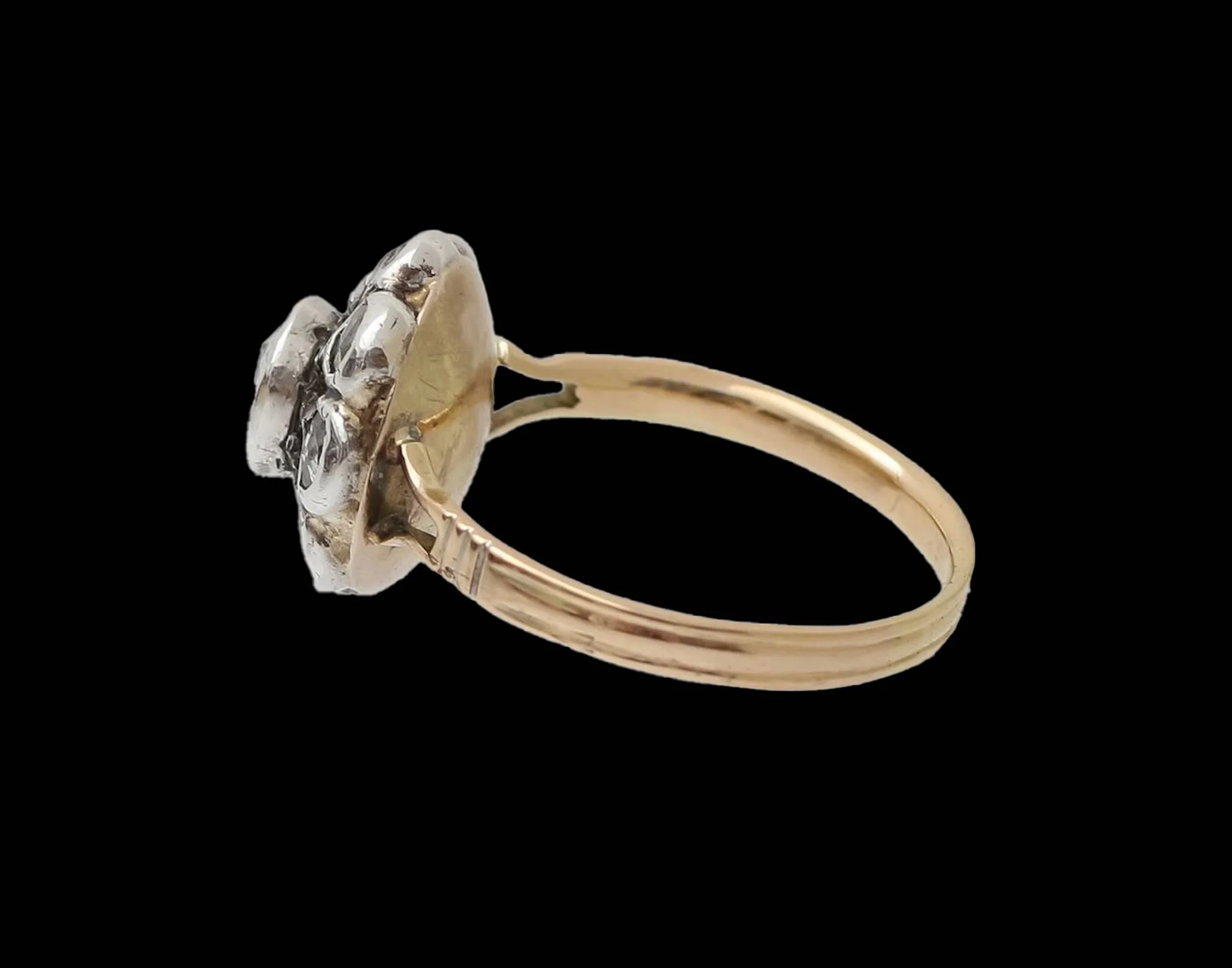 Image 2 of 3
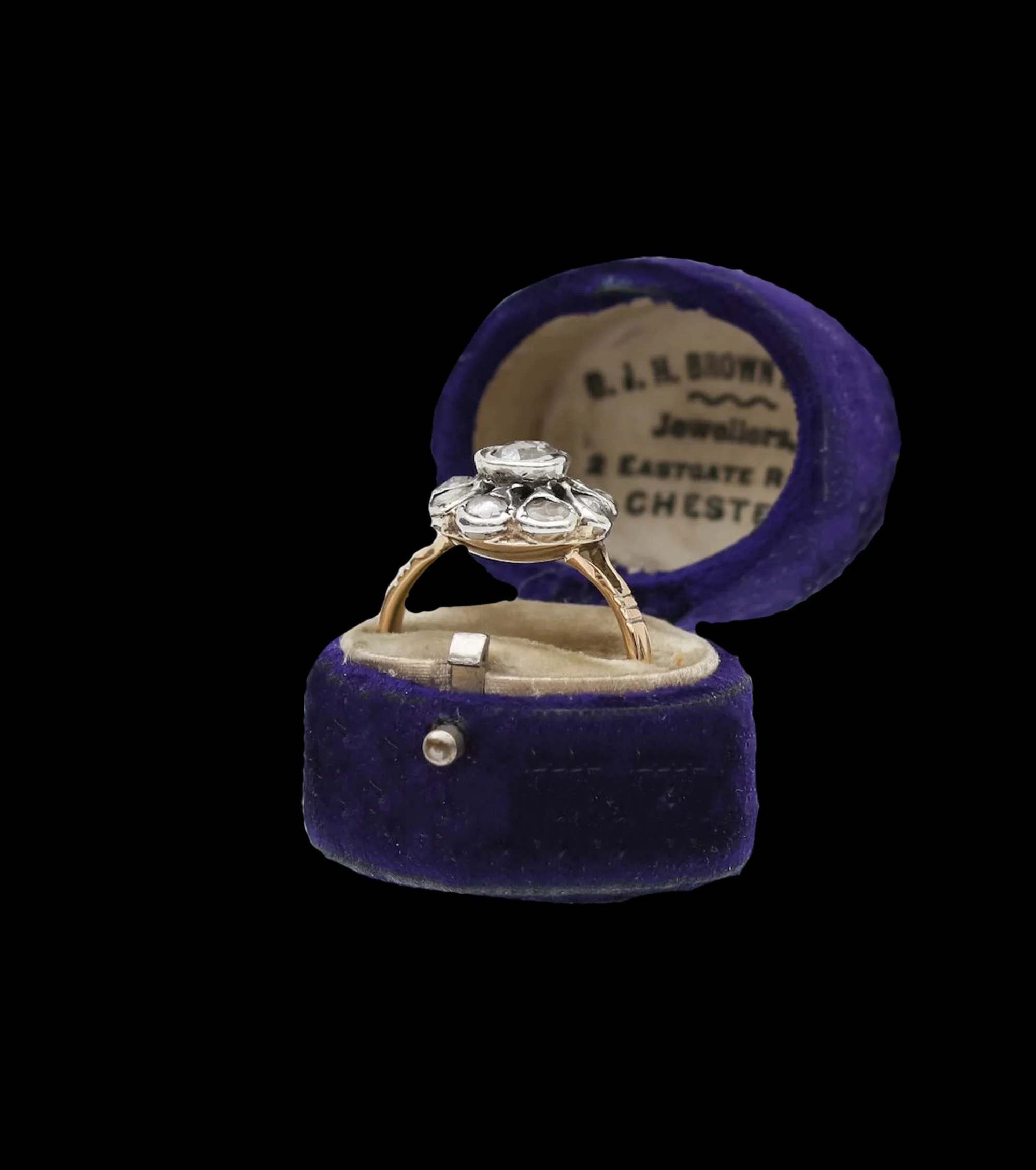 Image 3 of 3