

Gemstone Colour Symbolism in Antique Jewelry
Throughout the history of jewelry, gemstones have been valued for more than their rarity, beauty and brilliance. Their colours have carried associations with love, fidelity, purity, mourning, protection and spiritual devotion. A ruby might suggest the intensity of the heart, a sapphire the constancy of affection, and a pearl the innocence of a bride or the tears of a mourner. These meanings developed over centuries, drawing upon classical mythology, Christian iconography, medieval lapidaries, folklore and the changing social conventions of European society.
By the Georgian and Victorian periods, gemstone colour had become an important element of sentimental jewelry. A jewel might communicate affection through the selection of its stones, commemorate a loved one through their arrangement, or express a private sentiment through colours understood by the giver and recipient. Yet the symbolism of gemstones was never entirely uniform. Meanings varied according to culture, period, religious tradition and personal interpretation. The same pearl could signify bridal innocence or mourning, while the same red gemstone might represent passionate love, courage or protection. To understand antique jewelry, therefore, is to recognize colour as part of a larger visual language: one in which material, design, inscription and historical context contribute to meaning.
The Georgian Era: c. 1714–1830: Colour as sentiment, virtue and remembrance
Georgian jewelry developed within a culture deeply concerned with sentiment, morality, classical learning and the commemoration of personal relationships. Gemstones were often selected for their beauty and perceived virtues, but their arrangement could also express intimate feelings. Rings, lockets, brooches and pendants frequently incorporated coloured stones alongside enamel, miniature portraits, woven hair and memorial inscriptions. The eighteenth century inherited a rich tradition of gemstone lore. Medieval and Renaissance lapidaries had attributed protective, medicinal and spiritual properties to precious stones, while classical mythology connected particular gems with gods, virtues and human passions. Although such beliefs were not universally accepted as literal truths, their associations remained influential in jewelry design.
Red: Love, vitality and protection - Rubies and garnets were associated with the heart, passion, courage and vitality. Their rich red colour evoked blood and the life force, giving them particular resonance in jewels exchanged between lovers. Garnets, especially those with deep wine-red tones, became popular in Georgian jewelry. Their warmth complemented yellow gold and the intimate scale of sentimental rings. Red gemstones could also carry protective associations inherited from earlier traditions.
Blue: Fidelity, truth and constancy - Sapphires had long been associated with heaven, wisdom and spiritual truth. Their blue colour suggested constancy and loyalty, qualities particularly appropriate to betrothal and marriage. In Georgian jewelry, blue enamel could reinforce similar associations, although its meaning depended upon the jewel's wider design. Turquoise, admired for its distinctive blue-green colour, also possessed a long history as a protective stone.
Green: Hope, renewal and flourishing love - Emeralds were associated with spring, fertility, rebirth and hope. Their green colour recalled the regeneration of the natural world, making them appropriate symbols of renewal and affection. Peridots, chrysoprase and other green stones also appeared in jewelry, although they did not necessarily share an identical symbolic meaning.
White and black: Innocence, grief and eternity - Pearls possessed a particularly complex symbolic identity. Their whiteness suggested purity and innocence, while their resemblance to tears made them especially poignant in mourning jewelry. Seed pearls frequently surrounded miniature portraits, hairwork compartments and memorial inscriptions. In some memorial jewels, they evoked tears shed for the deceased. Black enamel, by contrast, became a prominent visual expression of mourning. When combined with pearls, gold and inscriptions, it created a powerful contrast between grief and enduring remembrance.
The Georgian fascination with sentiment also encouraged the development of acrostic jewelry, in which the initial letters of gemstones spelled a concealed word. A ring containing Ruby, Emerald, Garnet, Amethyst, Ruby and Diamond could spell REGARD, transforming a decorative arrangement into a declaration of affection. Such jewels reveal an important distinction: sometimes the meaning lay not in the colour of an individual stone, but in the sequence of gemstones selected.
The Victorian Era: 1837–1901: The gemstone as an expression of love, morality and loss
During Queen Victoria's reign, gemstone symbolism became increasingly intertwined with courtship, marriage, friendship and mourning. The Victorian fascination with coded communication extended beyond the language of flowers to encompass gemstones, colours, initials and symbolic arrangements. Jewelry could express affection discreetly, preserve the memory of a deceased relative or commemorate an important personal occasion. Queen Victoria's own jewelry and her widely publicized mourning following Prince Albert's death in 1861 helped shape the visual conventions of nineteenth-century sentimental and memorial adornment.
Ruby red: Passion and enduring affection. The ruby retained its association with love, courage and vitality. In Victorian sentimental jewelry, red stones could evoke the intensity of romantic attachment. Rubies appeared in engagement rings, heart-shaped pendants and jewels combining precious stones to form affectionate messages. Garnets offered a rich alternative, particularly in mid-nineteenth-century jewelry, when clusters of deep red garnets became fashionable.
Turquoise blue: Remembrance and affection. Turquoise became particularly popular in Victorian sentimental jewelry. Its blue colour could evoke the forget-me-not, the flower associated with remembrance and enduring attachment. Turquoise-set rings, lockets and brooches were sometimes fashioned into floral designs, reinforcing the relationship between gemstone colour and botanical symbolism. Turquoise also retained older associations with protection and good fortune. The stone's meaning was especially expressive when combined with pearls, hearts or forget-me-not motifs.
Purple: Spirituality, dignity and remembrance. Amethyst had long been associated with temperance, spiritual clarity and religious devotion. Its purple colour also suggested dignity and refinement. During the Victorian period, amethysts were worn in both fashionable and sentimental jewelry. Their subdued violet tones could be appropriate to periods of half-mourning, when strict black dress was gradually relaxed. Purple did not invariably indicate mourning, however. Amethyst jewelry was also worn simply for its beauty and fashionable appeal.
Black: Mourning, memory and devotion. Black acquired particular importance in Victorian jewelry following the death of Prince Albert. Whitby jet, carved from fossilized wood, became one of the most recognizable materials associated with mourning. Black onyx, black enamel, vulcanite and other dark materials were also used. Yet black jewelry was not exclusively funerary. Its polished surfaces and dramatic contrast with gold or pearls also made it fashionable beyond the conventions of bereavement. In mourning jewelry, black could signify grief, solemnity and the enduring presence of memory.
The Victorian language of gemstones – Acrostic Jewelry
One of the most distinctive expressions of nineteenth-century sentiment was the acrostic ring.
REGARD - Ruby · Emerald · Garnet · Amethyst · Ruby · Diamond. A declaration of affectionate esteem.
DEAREST - Diamond · Emerald · Amethyst · Ruby · Emerald · Sapphire · Topaz. A concealed expression of tenderness. These arrangements demonstrate how Victorian jewelers could transform gemstones into a literal vocabulary of affection. Not every multi-coloured antique ring is an acrostic jewel, however. Identifying one requires confirming the gemstones and their intended sequence.
The Belle Époque: c. 1871–1914 - Colour, light and the poetry of nature
The Belle Époque witnessed a transformation in the relationship between gemstones and symbolism. While the sentimental traditions of the Georgian and Victorian periods endured, jewelry increasingly reflected the artistic movements, scientific discoveries and cultural exchanges of the late nineteenth century. Two contrasting approaches emerged. The first favoured the brilliance of diamonds and the delicacy of pearls, often arranged in elaborate garlands and neoclassical compositions. The second, associated particularly with Art Nouveau, celebrated the expressive possibilities of coloured gemstones, translucent enamel and organic materials. In Art Nouveau jewelry, colour became an essential element of artistic expression. Designers such as René Lalique explored the relationship between gemstones, flowers, insects, mythology and the human form.
Opalescent white: Mystery, transformation and dreams - Opals became especially expressive within Art Nouveau jewelry. Their shifting colours and elusive luminosity complemented the movement's fascination with metamorphosis, water, moonlight and the mysterious qualities of nature. Opals had accumulated contradictory associations over the centuries. Some traditions connected them with hope and good fortune, while others regarded them as unlucky. Art Nouveau designers frequently valued them for their visual qualities rather than any single inherited meaning. Their iridescence suggested a world in perpetual transformation, where colour appeared and disappeared with the movement of light.
Green: Nature, regeneration and vitality - Green assumed particular importance in Art Nouveau jewelry. Emeralds, peridots, demantoid garnets and green enamel recalled leaves, stems, insects and the regenerative forces of nature. Translucent enamelling techniques, particularly plique-à-jour, allowed jewelers to reproduce the delicate appearance of stained glass and insect wings. In these compositions, green was often less a coded declaration of hope than an artistic expression of the living natural world.
White: Purity, luminosity and refinement - Diamonds and natural pearls were central to the more formal jewelry of the Belle Époque. Their pale brilliance complemented the fashionable preference for platinum, white fabrics, lace and delicate ornament. Pearls retained their associations with purity, femininity and bridal virtue. Diamonds, long connected with strength and endurance, were especially appropriate to jewelry commemorating marriage and lasting affection. Yet their prevalence also reflected fashion, wealth and advances in jewelry manufacture, rather than symbolism alone.
Violet: Spirituality, mystery and artistic imagination - Amethyst, purple enamel and violet-toned gemstones harmonised with the dreamlike imagery of Art Nouveau. Their colours could recall twilight, flowers and the mysterious atmosphere favoured by Symbolist artists. Amethyst retained its historical associations with temperance and spiritual clarity, although purple in an Art Nouveau jewel should not automatically be interpreted as a religious or moral statement.
Colour was increasingly employed to evoke an atmosphere or emotional response. The Belle Époque thus expanded the expressive possibilities of gemstone colour. A green enamelled dragonfly, an opal moonlit landscape or a pearl suspended beneath a diamond garland could communicate through visual suggestion rather than a prescribed sentimental code.
The Edwardian Era: c. 1901–1914 - The symbolism of light, purity and enduring affection
The Edwardian era, corresponding to the reign of Edward VII, coincided with the later years of the Belle Époque. The two periods therefore overlap chronologically. The distinction is principally one of cultural and stylistic emphasis: Edwardian jewelry refers particularly to British taste and its international influence, while the Belle Époque describes a broader European cultural period. Edwardian jewelry favoured refinement, symmetry and extraordinary technical delicacy. Advances in platinum working enabled jewelers to create intricate structures that appeared almost weightless. Diamonds and pearls were arranged in garlands, bows, wreaths and lace-like compositions. Coloured gemstones remained important, often providing a striking focal point within a predominantly white setting.
Sapphire blue: Fidelity, wisdom and enduring love. Sapphires remained closely associated with truth, constancy and loyalty. Their deep blue colour created a particularly striking contrast with diamonds and platinum. Sapphire and diamond engagement rings united the inherited symbolism of fidelity with the diamond's associations of strength and permanence. Such combinations could therefore be understood as expressions of enduring affection, although they were also fashionable choices.
Emerald green: Hope, renewal and prosperity. Emeralds retained their traditional associations with spring, regeneration and hope. In Edwardian jewelry, their vivid green colour provided a dramatic contrast with diamonds. Emeralds were frequently incorporated into rings, pendants and formal jewelry, where their colour could express both the vitality of nature and the prestige associated with rare precious stones.
Ruby red: Love, courage and devotion. The ruby remained a potent emblem of love and passionate affection. Set among diamonds, its intense red colour became the visual center of a composition. Ruby and diamond rings continued the sentimental traditions of earlier centuries while adopting the refined settings characteristic of Edwardian jewelry.
White Stones: Purity, constancy and eternity. The combination of pearls and diamonds became one of the defining visual expressions of Edwardian jewelry. Pearls evoked purity, innocence and classical femininity, while diamonds suggested permanence and strength. Together they were particularly appropriate to bridal jewelry, although their popularity extended far beyond marriage. Natural pearls were also exceptionally valuable. Their presence in a jewel could communicate wealth and social position as readily as sentiment.
In Edwardian jewelry, symbolism was often expressed through the relationship between stones rather than through colour alone. A sapphire surrounded by diamonds might suggest fidelity and permanence. A pearl suspended from a diamond bow could evoke feminine elegance and bridal purity. A ruby set within a garland might bring the warmth of romantic affection to an otherwise restrained composition.
The symbolism was inherited, but its presentation was distinctly modern.
A Chromatic Vocabulary: The Historical Meanings of Gemstones
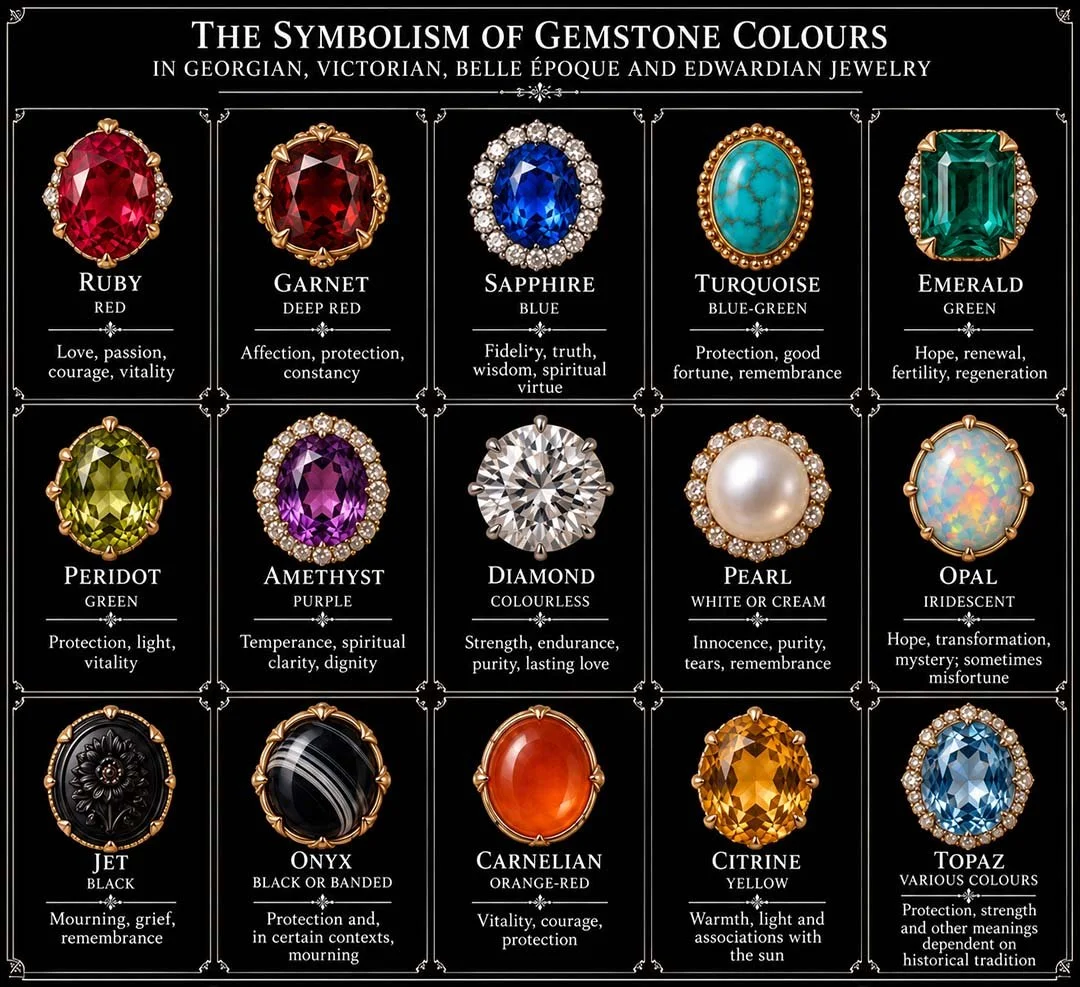
The significance of combination
Gemstones rarely existed in isolation from their settings. Their meaning could be transformed by their arrangement, the inclusion of symbolic motifs or the presence of a memorial inscription. A ruby in an engagement ring might communicate romantic love, while the same stone incorporated into an acrostic ring could represent merely the letter R. A pearl surrounding a portrait of a deceased child might evoke tears and innocence. In a bridal tiara, it could suggest purity and marital happiness. Similarly, black enamel surrounding a lock of hair conveyed a different message from black enamel used as a fashionable decorative contrast. The historical interpretation of gemstone colour must therefore consider the jewel as a complete object.
The Colour of Remembrance: Gemstones in Mourning Jewelry
Perhaps nowhere was the symbolic relationship between colour and emotion more apparent than in mourning jewelry. Throughout the Georgian and Victorian periods, jewels commemorating the deceased incorporated a vocabulary of black, white, blue and occasionally purple. Black enamel and jet provided visual expressions of mourning. White enamel was sometimes employed in memorial jewelry for unmarried individuals, although surviving examples do not establish a universal rule. Pearls could evoke tears, innocence and the purity of the departed. Blue enamel, particularly in combination with memorial inscriptions or forget-me-not motifs, could suggest remembrance and enduring attachment. Purple gemstones and fabrics became associated with certain stages of half-mourning, when the strict conventions of black dress were gradually relaxed. The significance of these colours was reinforced by other elements: woven hair, engraved names, dates of death, urns, willows and inscriptions such as In Memory Of. In these jewels, colour was not simply decorative. It helped articulate the emotional relationship between the living and the dead. A memorial jewel could be worn long after conventional mourning had ended, preserving an intimate connection that transcended the passing of time.
Birthstones and the Personalization of Colour
The association between gemstones and particular months has ancient and religious antecedents, including traditions connected with the twelve stones of the biblical High Priest's breastplate. Over time, various systems linked gemstones to the zodiac, the months of the year and individual virtues. By the nineteenth century, birthstone jewelry had become one means of personalizing a gift, although the lists used were not entirely consistent. It is important not to impose today's standardised birthstone chart upon Georgian or Victorian jewelry. A gemstone selected for a nineteenth-century birthday ring may have followed a different convention from the one familiar to modern consumers. Likewise, a multicoloured antique ring should not automatically be identified as a birthstone jewel. It may instead be an acrostic ring, a sentimental arrangement or simply a fashionable combination of gemstones.
The intention of the original giver is often impossible to establish with certainty.
The Enduring Language of Colour
Across the Georgian, Victorian, Belle Époque and Edwardian periods, the symbolic use of gemstones evolved alongside the societies that produced them.
In Georgian jewelry, stones frequently participated in a language of sentiment, virtue and remembrance. The Victorians expanded this vocabulary through elaborate conventions of courtship, mourning and personal commemoration. The Belle Époque introduced new artistic possibilities, allowing gemstone colour to evoke the natural world, dreams, sensuality and transformation. Edwardian jewelers refined the language of colour through delicate compositions of diamonds, pearls and precious gemstones, creating jewels that united inherited symbolism with the elegance of a new century.
Yet beneath these changing fashions lay a remarkably consistent human desire: to give permanence to feelings that might otherwise remain unspoken. A ruby could preserve the memory of love. A sapphire might express the hope of fidelity. A pearl could commemorate a marriage or a life lost. The gemstone endured long after the occasion that inspired its purchase. And while the precise intentions of its original owner may now be unknown, the jewel continues to communicate through its colour, craftsmanship and survival.
The enduring fascination of antique jewelry lies in this union of material permanence and human emotion.
A gemstone does not merely reflect light. It reflects the beliefs, affections and aspirations of those who chose to wear it.
In the hands of the jeweler, colour became memory made tangible.