

The Symbolism and Beauty of the Gold Vesta Case
Victorian 9K Gold Engraved Vesta Case, 1896
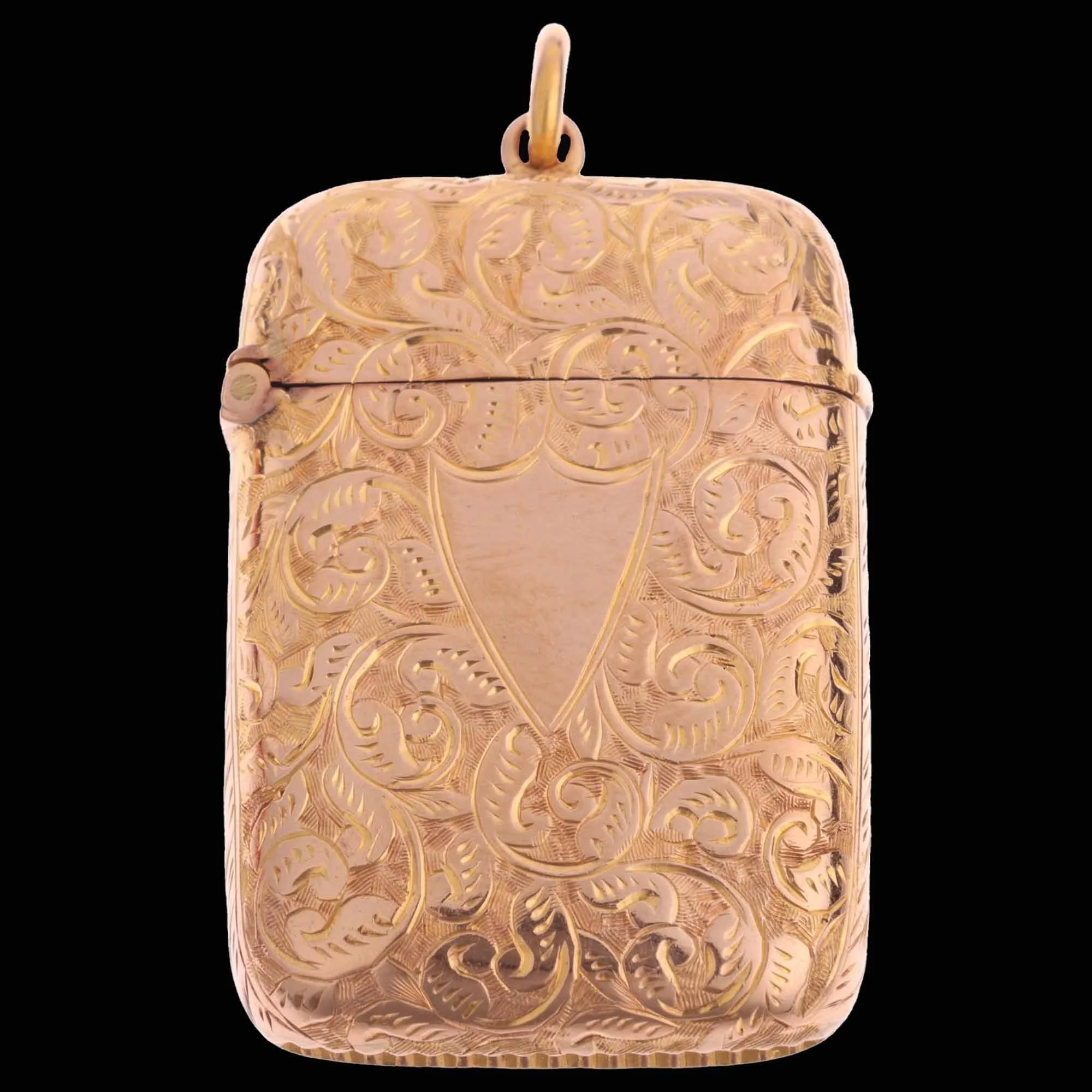
The gold vesta case occupies a unique place in the history of personal objects. Elegant enough to be worn as jewellery yet entirely practical in purpose, these beautifully crafted cases were designed to protect one of humanity's most precious commodities: the ability to create fire instantly. More than simple match holders, gold vesta cases embodied the Victorian ideals of preparedness, technological progress, refinement, and personal identity.
Named after Vesta, the Roman goddess of the sacred hearth and eternal flame, the vesta case inherited centuries of symbolic meaning long before the invention of friction matches. In Roman religion, Vesta's flame represented the continuity of home, family, and the state itself. Its careful preservation was considered essential to the survival of civilisation. By invoking her name, the Victorian vesta case became associated not merely with fire, but with protection, permanence, and the enduring comforts of domestic life.
The invention of reliable friction matches during the nineteenth century transformed everyday existence. For the first time, individuals could produce fire instantly without flint, steel, or tinder. Fire—once dependent upon skill, favourable conditions, or the careful maintenance of embers—became portable. The gold vesta case therefore symbolised one of the great technological revolutions of the Industrial Age: the ability to carry controlled fire safely in one's pocket.
As a result, the vesta case came to represent self-reliance and independence. Whether lighting a household lamp, igniting a fireplace, starting a railway carriage stove, or simply lighting a cigar, the owner possessed immediate access to warmth and illumination. Carrying a vesta case reflected a practical readiness for everyday life, mirroring Victorian admiration for resourcefulness and personal responsibility.
Gold added further layers of meaning. Throughout history, gold has symbolised permanence, purity, prosperity, and achievement. Unlike steel or brass, gold resisted corrosion while conveying wealth and refinement. A gold vesta case transformed an ordinary household necessity into an object worthy of artistic expression, demonstrating that even utilitarian possessions could embody beauty, craftsmanship, and social status.
The exterior of many vesta cases became miniature works of sculpture. Engraved ivy symbolised fidelity and enduring friendship. Oak leaves represented strength and steadfastness. Acanthus scrolls reflected classical ideals of beauty and intellectual achievement, while flowers conveyed sentiments ranging from remembrance to affection. Hunting scenes, sporting motifs, heraldic devices, monograms, and family crests transformed each case into a deeply personal object that reflected the owner's identity, interests, or social standing.
Perhaps the most distinctive feature of every vesta case is the ribbed striker, usually incorporated into the base. Although purely functional, it carries symbolic resonance. Fire itself was controlled only through deliberate action, reminding us that one of humanity's greatest discoveries required both knowledge and responsibility. The striker transformed the elegant gold case into an instrument of action, where craftsmanship met elemental power.
Many vesta cases were suspended from watch chains, Albert chains, chatelaines, or guard chains, making them constant companions throughout daily life. Like a pocket watch or seal, the vesta case formed part of the Victorian language of personal possessions. These carefully chosen accessories communicated taste, occupation, social position, and individual character without the need for words.
They also occupied an important place within rituals of sociability. Offering a light to another person was an act of courtesy and hospitality. Whether lighting a candle before dinner, a gentleman's cigar after a meal, or a lady's taper at home, the vesta case facilitated countless small interactions that reinforced Victorian codes of civility and mutual respect.
Many examples were presented as gifts to commemorate milestones including birthdays, retirements, military service, business success, or family occasions. Engraved inscriptions transformed these practical objects into lasting memorials, preserving names, dates, and personal relationships across generations. Today these inscriptions offer intimate glimpses into lives otherwise lost to history.
From a craftsmanship perspective, gold vesta cases represent remarkable achievements in miniature engineering. Their concealed hinges, spring-loaded catches, precisely fitted lids, and finely engraved surfaces required exceptional skill. Despite measuring only a few inches in length, they demonstrate the extraordinary precision of nineteenth-century goldsmiths and silversmiths, whose work elevated everyday necessities into enduring works of decorative art.
Viewed today, the gold vesta case is far more than an antique match holder. It represents humanity's enduring relationship with fire—the force that illuminated homes, fuelled industry, enabled travel, and transformed civilisation itself. It speaks to an age that celebrated invention while still revering classical tradition, combining practical innovation with artistic excellence. Though the friction matches they once protected have long since disappeared, these remarkable objects continue to preserve the story of a society that believed even the smallest tools of daily life deserved to be crafted with beauty, permanence, and meaning.