

The Symbolism of Tassels in Antique Jewelry
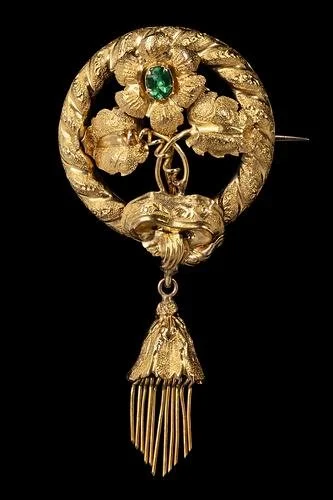
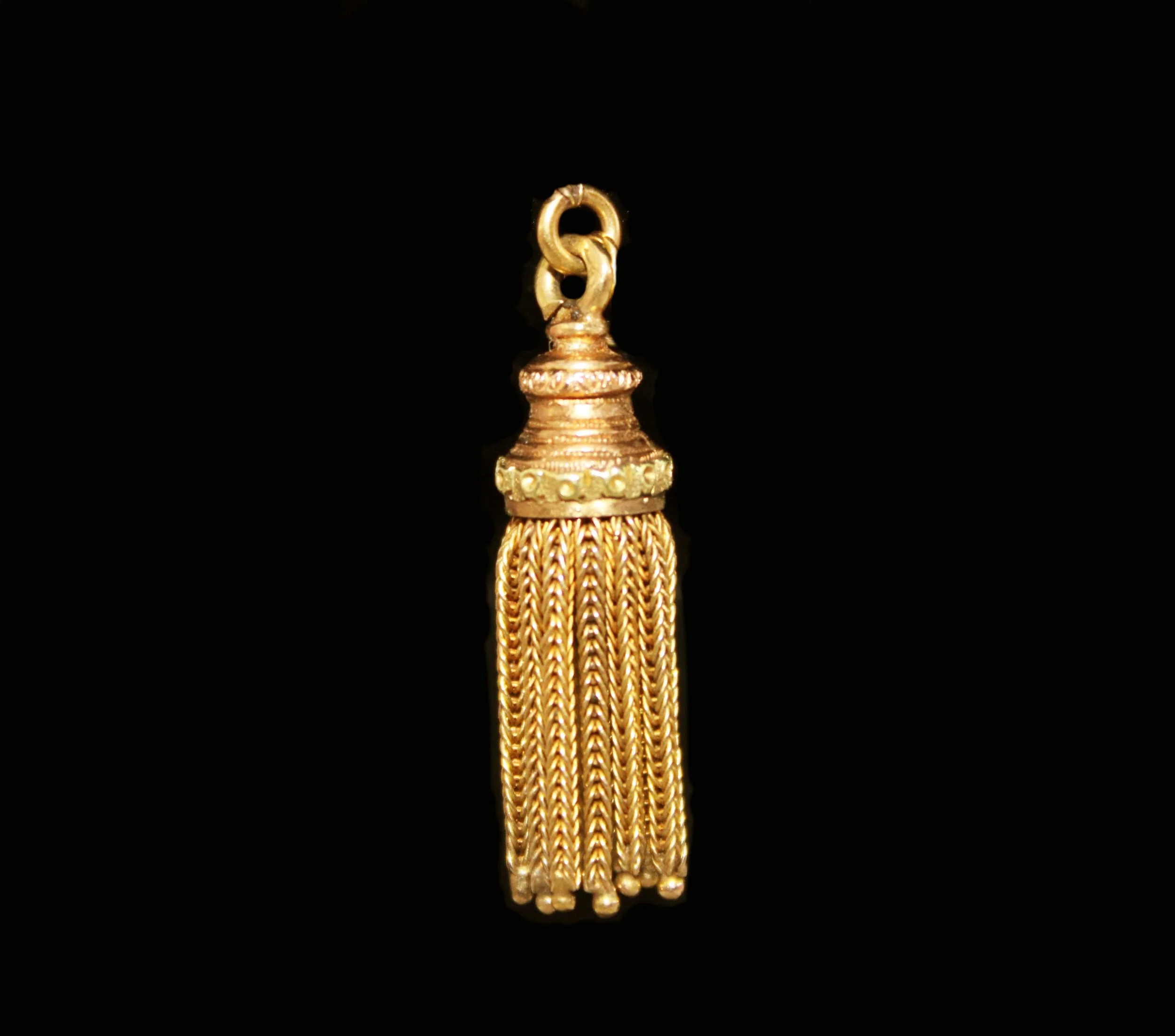
18K Gold Pompom Tassel
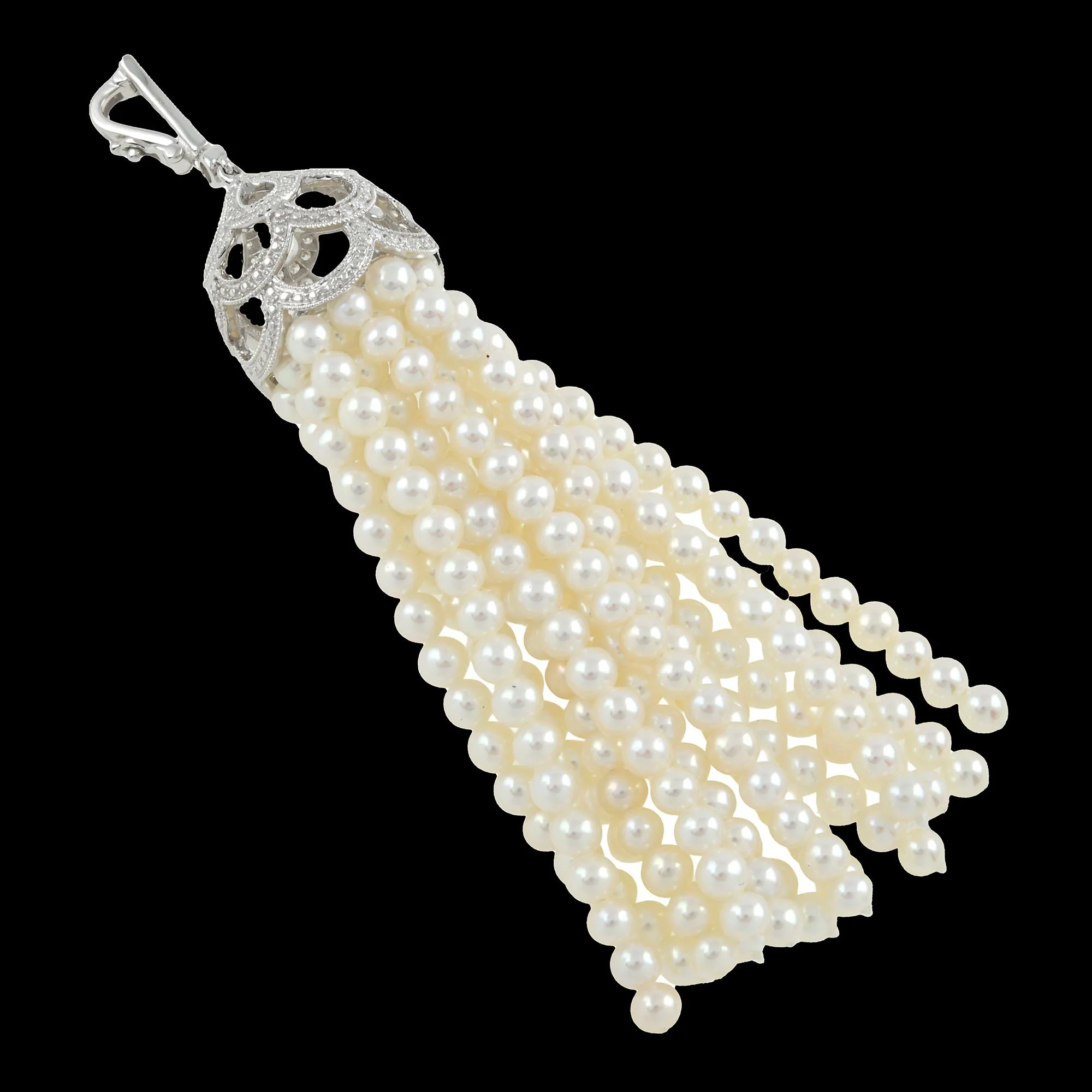
18ct Gold Diamond & Cultured Pearl Tassel Pendant
From Thread to Gold: Ornament, Movement and the Language of Luxury
The tassel is an ancient ornament with an unusually enduring history. Made originally from threads gathered, bound and allowed to fall freely, it has appeared for centuries on clothing, military and ecclesiastical dress, curtains and furnishings, ceremonial cords, horse trappings and objects of personal adornment. When translated into jewelry, however, the tassel underwent a remarkable transformation: something inherently soft and perishable was recreated in gold, pearls and gemstones. In antique jewelry, the tassel should not be understood as possessing a single, universally recognized symbolic meaning. Unlike the anchor, serpent, forget-me-not or mourning urn, whose associations can often be traced through contemporary literature and visual culture, the tassel operated more subtly. Its significance came from a combination of its history, materials, movement and longstanding associations with luxury and display. By the Victorian period and, later, the Belle Époque, jewelers had transformed this ancient textile form into some of the most sensuous and technically sophisticated jewels of their age.
An Ancient Language of Ornament
The origins of the tassel long predate the nineteenth century. Decorative fringes, cords and pendant ornaments appear in the material cultures of the ancient Mediterranean and Near East, and the idea of suspending multiple strands from a gathered point proved remarkably persistent. An extraordinary Hellenistic gold hairnet in the Metropolitan Museum of Art, dating to the first half of the second century BC, even retains a small loop beneath its central medallion that the museum believes probably once supported a decorative tassel. The object provides compelling evidence that tassel-like suspended ornament had entered the vocabulary of precious personal adornment more than two thousand years ago. Across subsequent centuries, tassels became closely associated with passementerie: the highly skilled manufacture of ornamental braids, cords, fringes and tassels used to embellish clothing and interiors. In aristocratic European culture these trimmings could be extraordinarily elaborate. Silk, metallic thread and other costly materials transformed practical fastenings and edges into conspicuous displays of craftsmanship and wealth. The tassel therefore entered jewelry already carrying a long visual association with luxury, ceremony and refinement.
The Transformation of Textile into Jewel
There is something inherently paradoxical about a gold tassel. A textile tassel is soft, fibrous and temporary. A jeweled tassel imitates those qualities in materials intended to endure. Goldsmiths recreated threads as chains, wires and articulated links. Diamonds became droplets of light. Seed pearls could imitate individual strands. Caps that would once have gathered silk threads became elaborately engraved, enameled or gem-set mounts. The resulting jewel retained the visual memory of textile while abandoning textile's fragility. This transformation also allowed jewelers to exploit one of the tassel's defining characteristics: movement. Unlike a rigid brooch or ring, a tassel responds continuously to its wearer. Its individual elements separate and reunite as the body moves. Polished gold flashes; diamonds scintillate; pearls shift against one another. The jewel is therefore never entirely static. Movement becomes part of its design.
Tassels in Victorian Jewelry
The tassel became particularly fashionable during the nineteenth century, when Victorian jewelry embraced archaeological revival, historical revival styles, elaborate goldwork and increasingly complex pendant forms. A remarkable surviving piece in the collection of Museums Victoria demonstrates how recognizable the fashion had become. Made in Melbourne around 1870 by Lamborn & Wagner, the gold brooch incorporates leaves, a flower, rope-like ornament and a bluebell from which hangs a gold-wire tassel. The museum specifically observes that the tassel brought an established goldfields brooch design into the fashion of the 1870s.
French jewelry designs preserved by the Metropolitan Museum of Art provide further evidence. A group of designs dating approximately 1870–1900 includes a gold pendant ornamented with a pink stone, quatrefoil motif, curved gold ropes and two suspended gold tassels. Another design incorporates a tassel beneath an elaborate earring set with a ruby, black diamonds and enamel. These drawings are particularly valuable because they demonstrate that the tassel was not an isolated eccentricity. It belonged to the working vocabulary of late nineteenth-century jewelry design.
Victorian jewelers were also fascinated by the ancient world. Archaeological discoveries encouraged designers to reinterpret Greek, Roman, Etruscan and other ancient ornaments. A Tiffany & Co. gold necklace and pendant of about 1880 in the V&A collection, for example, demonstrates the period's enthusiasm for archaeological-style jewelry and the creative adaptation of ancient forms for contemporary dress. Against this broader revivalist background, the tassel possessed a particularly useful ambiguity. It could appear ancient, Renaissance, Oriental, ceremonial or simply fashionable depending upon its execution.
Gold Tassels and the Display of Wealth
In Victorian jewelry, the symbolism of the tassel was inseparable from its material. A tassel made from silk already suggested skilled labour. A tassel made from numerous independently articulated components of gold represented something more extravagant: the deliberate transformation of abundance into ornament. One chain could perform the function of suspension. Ten, twenty or fifty tiny chains were unnecessary in any practical sense. Their purpose was visual richness. The tassel therefore made precious material conspicuous while retaining extraordinary delicacy. It could communicate wealth without requiring a single enormous gemstone. For this reason, the gold tassel may be understood less as a coded emblem than as an expression of luxury made visible through craftsmanship and movement.
The Belle Époque: The Tassel Becomes Ethereal
During the Belle Époque—the decades around the turn of the twentieth century before the First World War—the tassel reached another extraordinary stage in its evolution. The heavy richness associated with some nineteenth-century gold jewelry increasingly gave way to platinum, diamonds, pearls and exceptionally delicate openwork. Improvements in platinum jewelry allowed leading houses to create structures that appeared almost weightless.
Cartier became one of the great exponents of this aesthetic. The house's Belle Époque Garland style drew consciously upon earlier European decorative arts, particularly the eighteenth century. Museum scholarship on Cartier notes the importance of bows, tassels, floral swags and related European motifs within its early design vocabulary. The tassel consequently migrated from gold fringe into something resembling falling light. A Cartier Belle Époque sautoir dating to approximately 1890, for example, combined a seed-pearl lattice with diamonds and terminated in dual diamond tassels. By around 1910, the form could become even more dramatic. One Cartier sautoir consisted of a long seed-pearl necklace terminating in a pearl tassel beneath a diamond-and-onyx cap, mounted in platinum. Another surviving Cartier example combines a diamond, onyx and pearl tassel with an openwork pearl neckchain. The tassel had effectively been dematerialized.
What Victorian goldsmiths had rendered as articulated metal threads, Belle Époque jewelers could recreate as cascades of pearls and diamonds.
The Sautoir and the Moving Body
The rise of the sautoir, the long necklace worn falling down the torso, provided an ideal setting for the tassel. Its length allowed the terminal ornament to move independently of the neckline. Rather than sitting rigidly against the throat, the jewel participated in the movements of the body and the changing silhouette of fashionable dress. Period jewelry scholarship describes multi-strand seed-pearl ropes known as bayadères terminating in elaborate jeweled tassels, while flat woven seed-pearl sautoirs fashionable after about 1910 frequently ended in pearl-and-diamond tassels or elaborate pendants. A French Belle Époque natural-pearl and diamond sautoir of about 1910 recorded by Christie's demonstrates the sophistication of the type: five rows of natural pearls were gathered by diamond-set elements and accompanied by diamond tassel detailing in platinum. Here the tassel was not merely an ornament attached to a necklace. It provided its visual conclusion. The eye travelled downward along the long chain or ropes of pearls until reaching the tassel, where the ordered structure of the necklace dissolved into movement.
The Eighteenth-Century Revival
Belle Époque jewelers were not inventing the tassel anew. They were deliberately looking backward. The Garland style that flourished around 1900 drew heavily upon eighteenth-century decorative arts and the courtly vocabulary associated with Louis XVI: bows, ribbons, garlands, laurel leaves, swags and tassels. Cartier's development of this style reached its height around the turn of the century and continued until the First World War. Platinum allowed jewelers to reinterpret these historical motifs with extraordinary lightness, creating what appeared to be lace composed of diamonds.
The tassel therefore carried an additional association during the Belle Époque: nostalgia for aristocratic elegance. It belonged to an imagined world of silk gowns, tied ribbons, embroidered furnishings and courtly interiors, now reconstructed in platinum and diamonds for the modern woman.
East and West
The tassel also occupied an intriguing position between European and non-European decorative traditions. European designers of the nineteenth and early twentieth centuries were deeply interested in what they understood as Oriental, Islamic, Indian, Egyptian and Asian design. By the early twentieth century, houses including Cartier were systematically collecting and studying non-European art as sources for jewelry design. Long cords, fringes, suspended ornaments and tassels could therefore acquire an exotic or cosmopolitan character when incorporated into Western jewelry. This history requires some caution. It would be misleading to describe every antique tassel jewel as carrying an “Oriental” meaning. Tassels were already deeply embedded in European decorative traditions. Rather, their remarkable adaptability allowed them to move easily between cultures and revival styles. They could simultaneously suggest the European court, archaeological antiquity and an imagined East.
The Symbolism of Gathering and Release
There is also an evocative symbolic interpretation inherent in the construction of a tassel. Many individual strands are gathered at a single point, bound together, and then allowed to separate again. This form can therefore suggest unity and multiplicity, restraint and freedom, gathering and release. Such interpretations are visually persuasive, but they should not be mistaken for a documented Victorian symbolic code. There is little evidence that a nineteenth-century woman selecting a tassel pendant would necessarily have understood it to mean “unity” in the way that she might have recognized ivy as fidelity or forget-me-nots as remembrance. The distinction is important. The historical meaning of the tassel resides less in a secret dictionary of symbols than in the cultural associations accumulated around the object itself. Ceremony, Rank and Status Beyond jewelry, tassels had long appeared in ceremonial environments: military uniforms, ecclesiastical dress, academic costume, court clothing and sumptuous interiors. Their form therefore carried an unmistakable association with formality and distinction. Materials and construction mattered. Tassels could distinguish the ordinary from the ceremonial and the utilitarian from the luxurious. When reproduced in precious metal and gemstones, that inherited visual language became even more explicit. A jeweled tassel did not simply imitate thread. It transformed an established emblem of elaborate dress and ceremonial ornament into personal wealth.
The Seduction of Movement
Perhaps the most enduring significance of the tassel, however, is neither heraldic nor allegorical. It is kinetic. Jewelry has always had a relationship with the moving body, but the tassel makes that relationship unusually visible. Each step changes its configuration. Each gesture separates its strands. Candlelight, gaslight and later electric light animate its polished surfaces and gemstones. This quality would have been especially effective in evening jewelry. A diamond tassel of the Belle Époque was designed not simply to be looked at in a display case but to shimmer in motion. Its beauty existed partly in time.
From Victorian Gold to Belle Époque Light
The transformation of the tassel across the nineteenth and early twentieth centuries encapsulates a larger history of jewelry. In Victorian examples, tassels might be substantial constructions of yellow gold: tactile, architectural and emphatically material. By the Belle Époque, the same fundamental idea could be rendered as extraordinarily delicate falls of diamonds and seed pearls suspended from platinum. The form remained recognizable. Its substance changed completely. Gold became light. Thread became diamonds. Passementerie became haute joaillerie. And an ornament whose origins lay in gathered fibers became one of the most elegant expressions of movement in jewelry.
A Symbol Without a Single Meaning
The historical tassel is compelling precisely because its meaning cannot be reduced to one definition. It could evoke luxury, ceremony, craftsmanship, movement, rank, historicism and cosmopolitan taste. Its gathered construction can invite interpretations of connection and unity; its freely moving strands suggest animation and release. Yet these meanings overlapped rather than forming a rigid symbolic code. That ambiguity gave the tassel extraordinary longevity. Across centuries, cultures and changing fashions, jewelers repeatedly returned to the same deceptively simple idea: many slender elements gathered and then set free. In textile, the tassel marked an ending. In jewelry, it became something more enduring—a meeting point between softness and permanence, discipline and movement, ornament and symbolism. Perhaps that is its greatest paradox.
The jeweler took thread, one of the most fragile materials of human making, and translated it into gold, pearls and diamonds—preserving forever an object whose beauty was originally intended to move.