A Study in Contrast: An Early Twentieth-Century Sapphire and Diamond Cluster Ring
Early twentieth century, circa 1910–1930
An elegant example of early twentieth-century jewelry, this 18-carat white gold cluster ring combines the mysterious depth of a midnight-blue sapphire with the lively brilliance of old-cut diamonds. Its circular composition recalls the delicate petals of a daisy, a floral motif that enjoyed enduring popularity in European jewelry from the nineteenth century into the Edwardian and early Art Deco periods. At its center rests a round-cut sapphire weighing approximately 0.20 carats, its exceptionally deep blue coloration appearing almost black in subdued light. The sapphire is secured within a smooth rub-over setting, creating a continuous white-metal border that emphasizes the stone's circular form.
Surrounding the sapphire is a closely arranged halo of eight old-cut diamonds, with an estimated combined weight of approximately 0.40 carats. Their individually fashioned facets produce bright, lively reflections, creating a striking contrast with the dark, comparatively restrained appearance of the central gemstone. The diamonds are held within raised claw settings, allowing light to enter the stones and enhancing the distinctive brilliance associated with antique diamond cutting. The cluster is supported by an elegantly tapered white gold band, its open shoulders lending lightness to the composition.
The result is a jewel of understated sophistication, in which the interplay of light and darkness becomes the defining element of the design.
The Sapphire: Fidelity, Truth, and Celestial Protection
Sapphires have occupied a distinguished position in European jewelry for centuries, their rich blue coloration inspiring associations with heaven, divine favor, wisdom, and moral virtue. During the medieval period, sapphires were particularly esteemed within ecclesiastical and royal contexts. Their celestial coloration was associated with spiritual purity and heavenly contemplation, while their reputed protective qualities made them desirable gemstones for rulers and religious dignitaries.
By the nineteenth century, the sapphire had become firmly established within the sentimental vocabulary of jewelry. Blue gemstones were frequently associated with fidelity, constancy, sincerity, and enduring affection. These associations made sapphires especially appropriate for engagement rings and other jewels intended to commemorate personal relationships. The exceptionally dark blue sapphire in this ring creates a distinctive aesthetic effect. Rather than displaying the vivid cornflower coloration often associated with fine sapphires, its deep saturation lends the jewel an almost nocturnal quality, allowing the surrounding diamonds to provide the principal source of reflected light. Although its color may evoke the night sky, such an interpretation should be understood as an aesthetic association rather than a documented intention of the original maker.
Diamonds: Permanence and the Brilliance of Antique Cutting
The eight diamonds surrounding the sapphire belong to a tradition of gemstone cutting that preceded the widespread standardization of the modern round brilliant. Old-cut diamonds frequently exhibit individualized proportions, higher crowns, and facet arrangements that reflect the judgment of the cutter and the characteristics of the original rough crystal. Their brilliance is often described as warmer and more varied than that of modern precision-cut diamonds, producing distinct flashes of light rather than a uniformly calibrated pattern of reflection. In this ring, the diamonds are particularly bright and lively, creating an illuminated border around the dark central sapphire.
Throughout European jewelry history, diamonds have been associated with permanence, strength, fidelity, and enduring attachment. Their exceptional hardness contributed to their symbolic suitability for jewelry commemorating romantic commitments. The combination of sapphire and diamond therefore united two gemstones with complementary historical associations: the sapphire with truth and constancy, and the diamond with permanence and enduring affection. While these meanings were widely recognized within European jewelry traditions, the precise intentions behind this particular ring remain unknown.
The Daisy Cluster: Floral Symbolism in Early Twentieth-Century Jewelry
The circular arrangement of diamonds surrounding a central gemstone evokes the form of a daisy, one of the most enduring floral motifs in European decorative jewelry. During the Victorian period, the popularity of floriography, or the language of flowers, encouraged the interpretation of botanical ornaments as expressions of personal sentiment. Daisies were commonly associated with innocence, simplicity, loyal affection, and purity of feeling. Their modest appearance made them particularly suitable for jewelry intended to communicate sincere rather than ostentatious sentiment.
Floral cluster rings remained fashionable into the early twentieth century, when jewelers continued to reinterpret established nineteenth-century designs through increasingly delicate settings and the growing use of white precious metals. The present ring reflects this continuity. Its eight diamonds form a luminous floral halo, while the central sapphire introduces a strong contrast of color and texture. Rather than reproducing a botanical flower in literal detail, the design suggests its essential geometry: a dark central point surrounded by a radiating circle of light.
Historical Significance
This sapphire and diamond cluster ring illustrates the continuity of floral jewelry design across the transition from the Victorian era into the twentieth century. Its restrained proportions, white gold construction, and carefully balanced arrangement of gemstones reflect an aesthetic in which craftsmanship and the relationship between materials were valued above elaborate ornament. The exceptionally dark sapphire provides a dramatic center for the surrounding old-cut diamonds, whose lively reflections animate the composition. For the contemporary collector, the ring offers a compelling combination of historical symbolism, antique diamond character, and timeless design.
A circle of brilliant diamonds surrounding a midnight-blue sapphire, this jewel unites the traditional symbolism of fidelity and permanence with the refined elegance of early twentieth-century jewelry


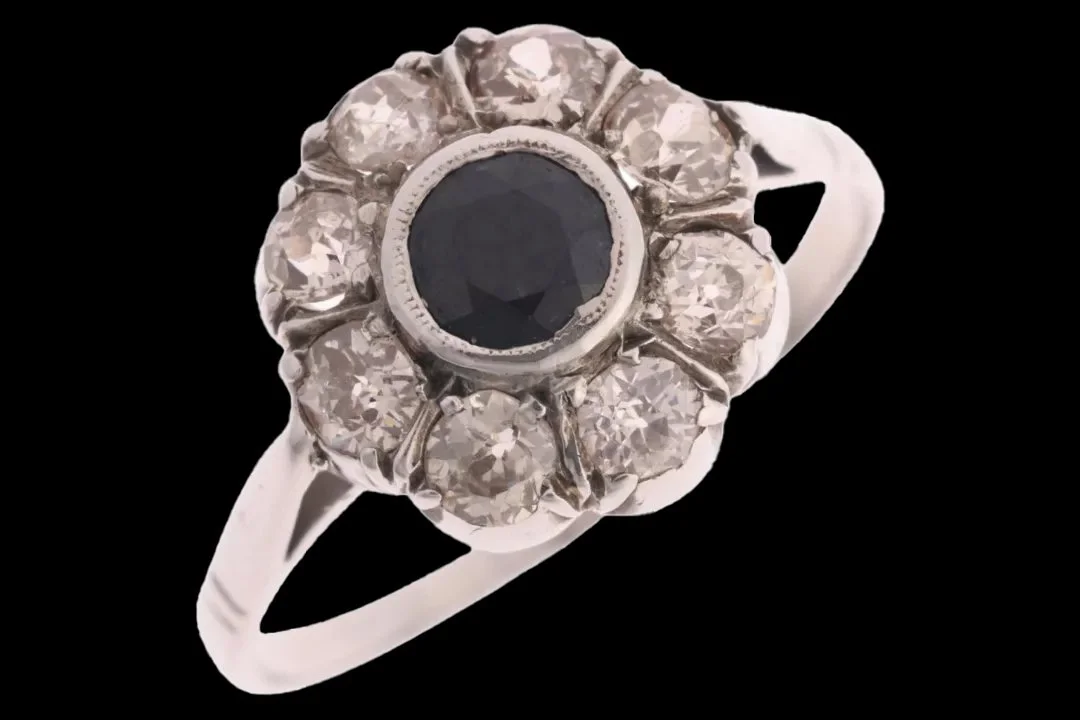 Image 1 of 2
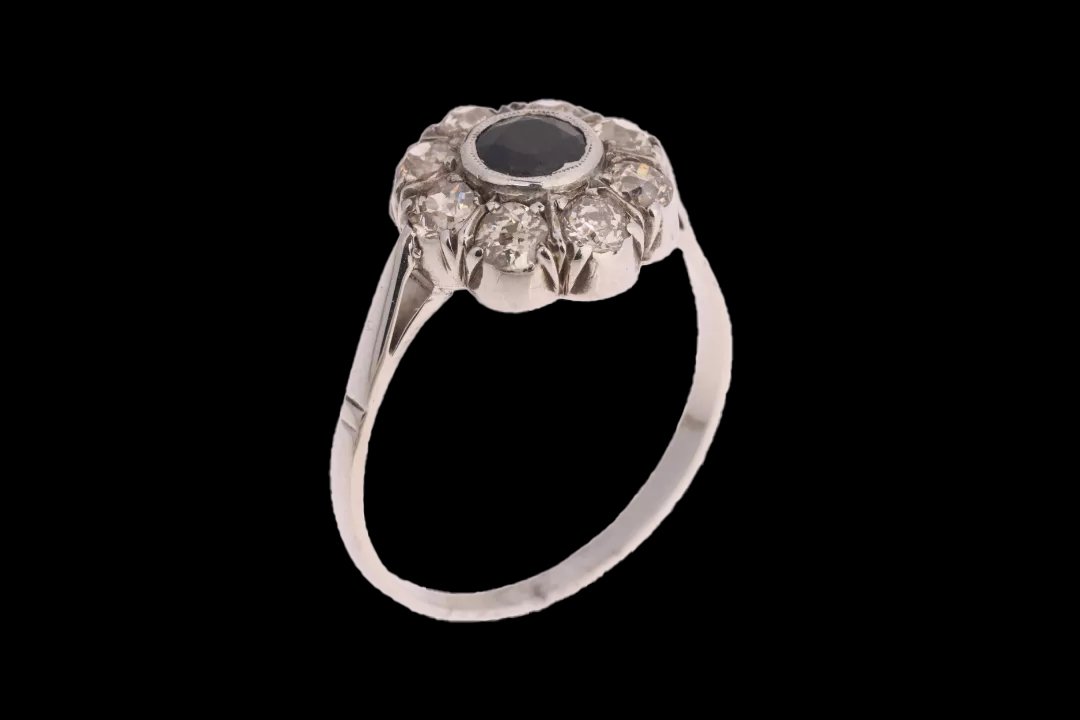 Image 2 of 2